Wherefore Art Thou Meaning?

"Wherefore Art Thou Meaning?" Many times while reading Shakespeare this is the main question on my mind. Through my own pondering & writing and hopefully some comments from others, I hope to find some answers.
Showing posts with label Hamlet. Show all posts

Monday, June 11, 2012

My Final Draft


Ophelia Drowning: Cleansing Herself of Social Roles

Ophelia is often portrayed as the poor little obedient girl “who lost it” with the death of her father.  This madness was a result of her loss of identity.  She relied on her father, Polonius, to make her decisions, only because he left her with no other choice.  Her father and the other men in her life had made all of her decisions for her and even told her what to say.  In result of this strong control over her, Ophelia struggled to find freedom even after the loss of her father.  Ophelia killing herself through drowning is a symbol of cleansing herself from the social roles and abuse that she had taken for so long; she was freeing herself from the world.  
“Frailty, thy name is woman.”  The 1948 movie adaptation of Hamlet stayed close to the text and gave good insight into the character of Ophelia.  However, I disagree with the movie and text that frailty is always a feminine attribute.  Ophelia is physically presented as a little girl with braids in the movie adaptation, going along with the presentations of many of her as a good little girl, always obedient to the will of the men in her life.  In the case of Ophelia, I am arguing that she was not frail or weak; she was simply never allowed any control over her life except at the end when she ended it (Olivier).  
“From the first, Ophelia’s psychic identity appears externally defined, socially constructed.  Although every human psyche might be said, from a psychoanalytic perspective, to be constructed largely as a result of social interactions, Ophelia’s unique development has given her an especially permeable psyche (Dane 406).”  Ophelia was motherless and completely controlled by the men around her.  She had been shaped to conform to the desires of others.  Her name derives from the Greek word for “help” or “greatest possible succor,” which is how men viewed her, a help to accomplish what they wanted.   Ophelia has been described as “that piece of bait named Ophelia.”  She was used, abused, and confused.  Her father, lover, brother, and king were all manipulating her and sending her contradictory messages (Dane 406).

“Both brother and father smother Ophelia in an incestuous stranglehold, each the self-appointed tutor of her moral, intellectual, even psychological development (Dane 407).”  When Ophelia begins to receive attentions form the Prince, both her father and brother become alarmed.  Hamlet and Ophelia’s relationship cannot possibly result in marriage, so they know the only result of the courtship would be disgrace.  The two men feel that Hamlet’s intentions are dishonorable.  And if Ophelia were to become pregnant, she would be ruined.  Laertes and Polonius know that a Prince is a persuasive suitor who may well be able to lead the virtuous woman in their family to go astray (Jenkins 209).  To Laertes, Ophelia is a chaste woman, and he sees it as his responsibility to protect her from the clutches of men.  He decides to teach his sister about dreaded male advances, “Fear it, Ophelia, fear it, my dear sister (Shakespeare 1.3.33).”  Ophelia answers her brother’s arguments about Hamlet’s intentions with questions (1.3.4-10).  Her questions open a protective space in which her thoughts remain private.  Laertes continues to give her instruction to stay away from Hamlet.  She never says that she will listen, but we know that she will obey her brother when it comes to her relationship with Hamlet.  However, her brother cannot change her thoughts and feelings for the Prince (Finkelstein 6-7).
Shakespeare’s plays often play more to father-daughter tensions than those between brother and sister.  Polonius is overly involved with his daughter’s love life, not only because he desires to advance politically, but also in the need to identify himself as a father.  In Polonius’s mind, he unites him and his daughter as one, saying “think yourself a baby (1.3.1056)”.  Polonius is attached to his daughter for his own gain; he shows no investment in Ophelia as a daughter, but only as an asset (Finkelstein 7).  When Ophelia’s father tells her not to spend time with Hamlet or to think of Hamlet, she simply listens to her father and obliges to follow his command.  This is only because her father does not give her a chance to choose.  Right after getting the command, she goes off and begins to think upon the wonderful Hamlet who has written her a love note, but her dad immediately appears and tells her to stop (Olivier).  He warns her that if she should act for herself, she will “tender [him] a fool” (1.3.109).  After keeping her from the Prince for days, he submits her to him, in order to prove his loyalty to the new king (3.1.4).  After Ophelia has been verbally and very likely physically assaulted by Hamlet through Polonius’s little love test, the king and councilor speak for seventeen lines before Polonius remembers to notice his daughter.  They then leave the room, offering no help to the hurt Ophelia.  To Polonius, his daughter, his lure, has served her purpose and is of no further use to him (3.2.109).  Wholly unconcerned with Ophelia’s needs, Polonius manipulates both her mind and her body to gratify his love of power.  Ophelia’s brother and father retard Ophelia’s psychic growth through their harsh usage of her, stifling her personal development to satisfy their own life (Dane 408).
Ophelia’s lover also disregards her needs for his own.  Hamlet visits Ophelia.  He is obviously flustered.  Hamlet grabs Ophelia and holds her hard, but then he holds her at arm’s length.  Hamlet attacks her emotions for him, sending her mixed messages of his own love.  He tells her that he has never loved her.  Any person who was so emotionally tossed around by men her whole life would certainly have issues with her own feelings.  He figures that Ophelia has been acting autonomously which he believes is wrong after the actions of his mother; in result, he becomes violently abusive toward her.  Ironically, she had been acting completing obediently to the will of men; the very thing that Hamlet wanted.  
People rely on their family and friends as a constant for them of love and support.  Instead, Ophelia’s father tells Hamlet’s parents that Hamlet is mad and shows Hamlet’s love letter for Ophelia.  They concoct a plan to show Hamlet at his worst, displaying his contrast of feelings for Ophelia, giving no consideration to the effect this will have on Ophelia.  She returns a favor he gave her.  Hamlet then begins to say that he loved her once, but that she should not have believed him.  He commands her to go to a nunnery, comparing her to a whore.  The way Hamlet talks to her is violent and commanding.  He pushes Ophelia roughly, says that there should be no more marriages, and leaves her crying on the floor after kissing her hand.  Then Hamlet’s uncle and Ophelia’s dad appear from behind the curtain.  Not even caring about her feelings, they go on with their plans to destroy Hamlet.  The end of part one has Ophelia lying on the stairs, looking up into the distance while sobbing.  Her father and the man that claimed to love her both hurt her in this scene and neither offers her any form of comfort.  For Ophelia, there is no support system which would suggest a result of low self-worth (Olivier).
“Indeed with her identity constructed always in reference to another, Ophelia is, in essence, nothing, an empty cipher patiently waiting to be infused with whatever meaning the particular mathematician should require.  Lacking personal ego boundaries of her own, Ophelia seems compelled to absorb whatever psychic identity is thrust upon her (Dane 410-411).”  Ophelia does not know how to think for herself, because she has never been allowed this great privilege. Male voices fill her head, guiding her every thought.  With her brother in France, and her lover suddenly banished to England for the murder of her father, the voices stop.  “Confronted with such a thunderous silence, Ophelia becomes mad (Dane 411).”
Ophelia begins to ramble, a sign that she no longer knows what to say without her father’s guidance.  The mad songs that Ophelia begins to sing reflect on all the major issues of the play.  Each “fragment of a popular ballad (4.5.23-40)” contains numerous levels of accusation and mourning, along with protest and longing (Dane 414).  The first song mourns for her father and accuses of a hasty burial, indicts Gertrude for no distinguishing between lovers, and the longing for her banished love, Hamlet (Dane 414-415).  Ophelia is enacting a funeral- but not simply in her father’s honor- with her lamentation, accompanied by her distribution of flowers (Dane 417).  Ophelia gives the appropriate flowers to each party.  To Laertes, she gives rosemary and pansies which signify remembrance and thoughts, because she wants to be remembered by him.  Gertrude receives fennel and columbines which represent marital infidelity.   Ophelia gives King Claudius rue and a daisy, which stand for repentance and a love doomed to be unhappy.  This makes it appear that she was staging an elaborate elegy in honor of the whole company.  Dane quotes Cherrell Guilfoyle, who suggests that these flowers were funeral flowers to be handed to those who would shortly die- the King, the Queen, Laertes, and herself (Dane 417).
Dane asks the question that although Ophelia found a way in which to express her frustrations and protest against the community’s wrongdoings, has Ophelia really found “an autonomous voice, a discrete self?”  Even though Ophelia’s not-so-random ramblings express how Ophelia feels, Ophelia is still speaking in quotation.  Her voice is still fragmented through the words of others.  Her father, brother, and lover may no longer tell her exactly how to think, speak, and act, but Ophelia is now speaking through ordinary but disjointed speech comprised of popular ballads, traditional legends, routine pieties, even familiar expressions of greeting and farewell (Dane 419).  
Ophelia’s final mad scene, when she disperses funeral flowers to the company, may be seen as a determined farewell.  Rue was the flower that Ophelia presented to herself.  This flower signifies repentance, which seems appropriate for a woman contemplating her own death.  Through this interaction with those who should care about her, you can see her trying to make that final connection that those close to suicide tend to make, remember me.  Even that last cry for help does not solicit a reaction from those she reaches out to.  
Ophelia does not know how to speak for herself through her own thoughts.   By losing her father’s iron-clad guidance, Ophelia has lost part of her identity.  She no longer knows how to function.  I imagine this would be a lot like having someone guide you through a place that is dark and unfamiliar to you, for them only to leave you at the most difficult part of the journey.  The fear or the unknown is terrifying.  A fear of identity theft through the use of the vast Internet is frightening to many people.  For the most part, the Internet is a guide, a useful tool, but we are becoming reliant on this technology to the point that we will often rather turn to the Internet for an automatic answer rather than take the time to contemplate the question in our own mind.  The Internet, like Polonius (who should have been a good father and a good guide), can turn on you.  Many people use the Internet as a weapon to hurt others and steal identities.  How lost would each of us be if our information was stolen on the Internet?  Would you ever be able to trust another source of information again?  These examples of fear are comparable to how Ophelia would have felt to lose her sources of guidance.  Ophelia, however, did not know how to function without this guidance.  Instead, she chooses to end her life.
Ophelia’s drowning was an act of partial self-awareness.  The question then must be asked if her death was a deliberate act, a suicide.  In Hamlet, the gravedigger says if the water comes to the man, “he drowns not himself.”  But if the “man go to this water”…?  The gravedigger concludes that it is quite simple: “He that is not guilty of his own death shortens not his own life (5.1.15-20).”  The accounts from Gertrude and the gravedigger leave room for interpretation.  The most that Shakespeare gave in his words of Ophelia’s purpose was her unwillingness to resist succumbing to a watery grave (Dane 422).”
Dane and I suggest that in the reflection of the water, Ophelia finally recognizes who she is and decides to merge with it.  After struggling with her first experience to express her feelings, Ophelia emerges to make her first autonomous choice (Dane 423).  “Ophelia decides that in order authentically “to be” she must choose “not to be (Dane 423).””  As Ophelia floats down the river, she begins to sing, and then she drowns.  Singing is a source of comfort.  Ophelia uses this to allow her to follow through with the decision she has made (Olivier).  
Dane says, “While the notion that suicide becomes the only possible route to autonomy for this woman is undeniably tragic, Ophelia’s choice might be seen as the only courageous- indeed rational- death in Shakespeare’s bloody drama (Dane 423).”  Ophelia decides to commit suicide in order to release herself from the power and manipulation that the men in her life had over her.   Ophelia’s dressing in white symbolizes her innocence and her desire to be cleansed.  Faith is also usually represented by the color of white, so her white dress can be her hope for a better situation through her death.
Ophelia was not frail, but she was pushed to the point where only her frail persona remained.  She could no longer keep up the façade to keep everyone happy but herself.  Ophelia chose to allow herself to escape the bonds of social roles.  She could no longer let herself be the obedient daughter and young woman who did everything she was told.  Ophelia could make this one choice without experiencing any social consequences.  The sense of resulting freedom from the choice she was about to make allowed Ophelia the power to follow through with her own first true decision.  She cleansed herself from the power her world had over her by choosing not to be (Olivier).
2,396 Words


Works Cited
Dane, Gabrielle. “Reading Ophelia’s Madness.” Exemplaria 10 (1998): 405-23.
Finkelstein, Richard. “Differentiating Hamlet: Ophelia and the Problems of
Subjectivity.” Renaissance and Reformation 21.2 (Spring 1997): 5-22.
Jenkins, Ronald Bradford. “The Case Against the King: The Family of Ophelia vs. His Majesty
King Claudius of Denmark.” Journal of Evolutionary Psychology 17.3-4 (Aug. 1996): 206-18.
Hamlet. Dir. Olivier, Laurence Kerr. Prod. Laurence Kerr Olivier. Perf. Laurence Kerr Olivier, et al. Film. Two Cities Film, 1948. February 18, 2012 <http://ativ.alexanderstreet.com.erl.lib.byu.edu/view/657516>.
William Shakespeare 1564-1616. The Tragedy of Hamlet, Prince of Denmark. Eds. Barbara A Mowat, Paul Werstine, and Folger Shakespeare Library. New York: Washington Square Press, 2004, c1992. Print. Hamlet .

Monday, May 7, 2012

Ophelia Picture Compilation

As Dr. Burton has mentioned about my blog, I have found a lot of inspiration from the pictures of Ophelia I have found online.  While searching YouTube, I found this video of a compilation of pictures set to music.  Many of these I have seen while doing my research.  Enjoy!

Monday, March 5, 2012

New Paper Form, New Ophelias

Many of us probably recognize Helena Bonham Carter for her unique and dramatic roles, and the scenes I have seen of her as Ophelia in Hamlet are just as well done.  Ophelia went through a lot in her young short life, just as a traditional research paper does.  They are both used, abused, and confused in different ways.  Ophelia had multiple authors, if you will, shaping her every word and idea to rigidly fit their ideal.  Traditional research papers have a standard and rigid format as well, where little freedom can be taken to express new ideas.

While meeting with Dr. Burton, he asked me to consider ways to apply my paper to an audience outside of the scholarly realm and challenged me to think of new ways to present my paper to incorporate different media types in both the presentation and application.  I believe my paper expressed my ideas well, but they just did not come to life as they would have with the help of supplementary media material.

As I have begun exploring applications for my research during the writing process, I have considered studying Ophelia's loss of identity experience with the loss of her father, brother, and lover to the fear of loss of identity through Internet usage.  While meeting with Dr. Burton, we also discussed how the rigid format expected of traditional research papers are the Poloniuses of the scholastic world.  They leave little room for expression and femininity.  This presented the opportunity to argue that the old way of writing papers is the masculine form, where the new form, allowing writers to present their works in a new creative format, is the free and feminine form of expression.  The idea of being able to present your information in a form such as a Prezi presentation, would allow me to show the artwork that has supported my arguments in my blog, along with movie clips and other media to truly show the nature, psychology, and life of Ophelia.

When it comes to an audience, a very realistic one would be young girls experiencing Ophelia Syndrome.  I feel that a way to do this might be to create an appealing and interactive Prezi presentation that teaches about the dangers of this problem through the experiences of Ophelia.

Tuesday, February 28, 2012

Posted Draft


Here is the early draft, more outline, of my paper.  There is still a lot of work to be done.  If I could receive some feedback, I would really appreciate it! :)

Monday, February 27, 2012

"Tweethis" Statement

I posted my "Tweethis" statement online on multiple social networking sites, such as Facebook, Twitter, Google+, and Goodreads.  My only responses were on Facebook.  The "Tweethis" statement was "Ophelia killing herself through drowning is a symbol of cleansing herself from the social roles and abuse that she had taken for so long."  My fiance responded with the fact that suicide is never the answer, and that is very true.  My paper is on why that was the only choice Ophelia felt she had left.  

 My friend Josh, who recently changed his major from English Teaching to English with an emphasis in Creative Writing.  He liked my theory and led me to another work, which I sadly have not had time to read.  This support of my theory and the responses to my discussion on Goodreads have helped me to see that my "Tweethis" statement is valid, and that people actually care about it.


I had taken a new direction from my original thinking by focusing on the decision of drowning and of the loss of identity at the loss of Ophelia's father, because she no longer had him to make all of her decisions.  From reading the responses online, I knew I was headed in the right direction.

Saturday, February 25, 2012

"Tweethis" Statement

Posted on Facebook, Twitter, and Google+:
"Ophelia killing herself through drowning is a symbol of cleansing herself from the social roles and abuse that she had taken for so long."
What do you think about Ophelia's death in Hamlet?


Monday, February 20, 2012

Taking the Plunge Into Research...Getting My Feet Wet In Social Media


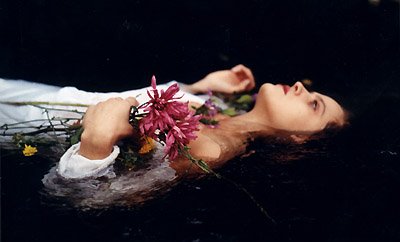
Doesn't she look like she is just releasing herself from life and from her social roles?

Honestly, at the end of this week, the picture above represented me pretty well.  Nothing seemed to go right for this class this week.  I was not able to do as many social connections as I wanted, simply because I did not have any time...which may have been because nothing went as planned for my research.  

Usually, I am pretty skilled at finding articles and making them fit my paper, but the articles that I had found an interest in and that applied well for my paper this time around could not be found anywhere on the internet for free.  As I explored more and more, I got pretty discouraged, but then I thought, "Why not try interlibrary loan?," which I have recently realized the value of as I have been doing research for my other research paper this semester, on Maori English for my linguistics class (I am pretty excited about it!).  Now, I am just waiting to hear back from them to get the articles, and I will continue exploring my options for research.

Before all the failure of article finding, I had watched the 1948 version of Hamlet, which was valuable, because a line caught my attention which never had before, "Frailty, thy name is woman."  Hamlet is referring to his mother's quick mourning time and marriage to his uncle.  But he is also referring to all woman and what he considers their normal fickle behavior.  That of course also made me more aware of all the violence, physical and emotional, that Ophelia goes through, especially from Hamlet and her father.  In a way, Ophelia killing herself through drowning is a symbol of cleansing herself from the social roles and abuse that she has taken for so long; she is freeing herself from the world.

I have not used Prezi much at all, so I thought that might be a good place to explore for what others are saying about Ophelia.  I found multiple presentations, and I posted a few of my favorite ones in a recent post along with what I learned from each one.  I gained some insight on how Ophelia lost part of her identity when she lost her father, because he had taken such strong control over her life.

My social connections were not as many as I would have wished, but I am really enjoying hearing what others have to say on my Goodread's discussion page.  I really enjoyed Katie's words on how many articles have a sexist undertone, because it is very true.  Tomorrow, I am hoping to write many of the scholars of whom I have read their articles on Ophelia.  It would be so exciting if I could hear back from at least one of them!

Also for this week, I need to get my "tweethis" statement finalized and posted on Facebook, Twitter, and Google+, to try to get some feedback on it.  I am planning on getting my first draft written and posted.  Then, I will give feedback on my peers' papers and hopefully get some feedback for my own paper.


Saturday, February 18, 2012

Social Networking Follow-Up

I tried to start up a conversation on the Ophelia Community page on Facebook, but so far, there has been no success.  However...on my Goodread's discussion page, I have had some responses.

This has been my favorite social connection so far.  I am trying to get the conversation headed more towards the current direction of my paper, but I really liked what Katie had to say about many of the articles written about Ophelia.  Many of them do have a sexist undertone to them, and I am excited to write a paper showing Ophelia as something other than a silly weak girl.

Prezi on Ophelia

I decided to look at some presentations on Prezi to see how others were interpreting Ophelia.

The first one describes how it is difficult to pinpoint Ophelia's character and explores different interpretations of Ophelia in multiple media forms.  This was probably my favorite Prezi presentation that I found, because of the variety of views that it gave.  


I particularly liked this music video called "Ophelia" that is supposed to be from Hamlet's perspective.

The next presentation that caught my eye was "Ophelia The Suicidal Lover.  I really liked how it presented Ophelia with "helper's syndrome," where some girls like to be in relationships where they are needed to help the other person.


Another interesting title caught my attention, "Welcome to Crazy Town, Ophelia."  This presentation basically tears the character of Ophelia apart and says that Ophelia is a symbol but a necessary one.  I really liked the style of the presentation, but it goes against what I am trying to prove.  I want to find literary proof against the assumptions made in this presentation.  I feel that this will help to strengthen my argument for my paper.


This next presentation highlights how Ophelia is told to do everything she thinks and does, even being told that her own love for Hamlet is a delusion.  I feel that this presentation would look a little more professional if it did not have so many spelling errors.  


This final presentation really highlights Ophelia's insanity well, especially in the BBC clip.  When Ophelia looks into the shattered mirror, her reflection shows her shattered self, her loss of reality.  This presentation really follows one of the themes for my paper.  It discusses how her father had such control on her and made all of her decisions, so after he dies, she has no one to tell her what to do; she is lost, because she lost part of her obedient identity, forever loyal to her father.  Anderson goes on to say that her rambling speech is because she does not know what to say.  Her father used to give her script of what to say, but that is no longer there for her.


When Ophelia visits Hamlet's mother and uncle, Ophelia says that people know who they are, but not what they may be.  Do you think that Ophelia knows who she is at the point that she utters these words?


Ophelia Bibliography


The research process has been difficult.  Many of the articles that I want to read about my topic have been difficult to come by in complete form.  I am hoping to have more success as I keep exploring.  I searched all the databases online for these articles, but access is not available online through BYU or anywhere online where I have looked without a paid subscription.  These sources I have found I am waiting on through interlibrary loan.  I know this takes more time, but I feel these articles are more applicable to my topic.  Hopefully, I will get access to them soon.

Tweethis: Ophelia is abused physically and emotionally by the men in her life; this continual abuse and emotional confusion lead to her insanity.

Dane, Gabrielle. "Reading Ophelia's Madness." Exemplaria 10 (1998): 405-23.
Dane argues from a feminist perspective that in Hamlet Ophelia's psychic identity is circumscribed by a male-dominated world, from which her madness- a feminist means of protest, an act of self-empowerment- offers an escape.

Finkelstein, Richard. "Differentiating Hamlet: Ophelia and the Problems of Subjectivity." Renaissance and Reformation 21, no. 2 (1997): 5-22.
By considering the positions Hamlet explores with regards to the nature of intention, the nature and acquisition of knowledge, the effectiveness of reason, and their relation to psychological integrity....argues that Shakespeare evaluates the play's participation in the project of defining subjectivity"--particularly through the challenge that Ophelia poses to Hamlet's, Claudius's, and Polonius's assumptions about the self. English summary, 5.
I found this article while exploring online.  It seems to fit what I am trying to prove in my paper.  Ophelia is used to challenge the assumptions about the self.  I have requested the article and am simply waiting for access to it.

Harris, Arthur John. "Ophelia's 'Nothing': 'It is the false steward that stole his master's daughter.'" Hamlet Studies 19 (1997): 20-46.
Finding that comments by other characters about Ophelia emphasize her sexuality and that her mad ravings suggest a liaison with Claudius, expands J. Max Patrick's "The Problem of Ophelia" (1953) to argue that Ophelia is a victim of sexual abuse and murder at the hand of the King.
I saw that Harris was a writer on Shakespeare's works.  As I explored, I found this article which seems perfect for my paper, because I am trying to prove that Ophelia's personality and insane behavior at the end of the play are a result of abuse from the male characters in her life.

Jenkins, Ronald Bradford. "The Case against the King: The Family of Ophelia vs. His Majesty King Claudius of Denmark." Journal of Evolutionary Psychology 17, nos. 3-4 (1996): 206-18.
Argues that Ophelia is a victim of Claudius's, rather than Hamlet's, machinations: Claudius seduced and impregnated Ophelia and then murdered her to prevent the birth of their bastard son.
While looking for information about Ophelia online, I found a site with articles about certain characters in Hamlet.  This one goes along with the article above and seems quite interesting.  I really want to see the textual proof for this paper.

Hamlet...1948


First off, the lighting and the black and white helped to create a dreary mode for the whole movie, giving it the appearance of a tragedy.  Also, the kissing scenes between Hamlet and his mother were quite awkward.....


"Frailty, thy name is woman."  The 1948 version of adaptation of Hamlet stayed close to the text.  However, I disagree that frailty is always a feminine attribute.  Ophelia is physically presented as a little girl with braids in the movie adaptation, going along with the presentations of many of her a good little girl, always obedient to the will of the men in her life.  When her father tells her not to spend time with Hamlet or to think of Hamlet, she simply listens to her father and obliges to follow his command.  This is only because her father does not give her a chance to choose.  Right after getting the command, she goes off and begins to think upon the wonderful Hamlet who has written her a love note, but her dad immediately appears and tells her to stop.


Hamlet visits Ophelia.  He is obviously flustered.  Hamlet grabs Ophelia and holds her hard, but then he holds her at arm's length.  Hamlet attacks her emotions for him, sending her mixed messages of his own love.  He tells her that he has never loved her.  Any person who was so emotionally tossed around by men her whole life would certainly have issues with her own feelings.  People rely on their family and friends as a constant for them of love and support.  Instead, Ophelia's father tells Hamlet's parents that Hamlet is mad and shows Hamlet's love letter for Ophelia.  They concoct a plan to show Hamlet at his worst, displaying his contrast of feelings for Ophelia.  She returns a favor he gave her.  Hamlet then begins to say that he loved her once, but that she should not have believed him.  He commands her to go to a nunnery.  The way Hamlet talks to her is violent and commanding.  He pushes Ophelia roughly, says that there should be no more marriages, and leaves her crying on the floor after kissing her hand.  Then Hamlet's uncle and Ophelia's dad appear from behind the curtain.  Not even caring about her feelings, they go on with their plans to destroy Hamlet.  The end of part 1 has Ophelia lying on the the stairs, looking up into the distance while sobbing.  The camera ascends up the stairs like Ophelia is watching it.


Part 2 begins with a distressed Hamlet on the ground in a similar position.  He is looking up too, but Hamlet is looking at the camera, his father's ghost.  It was very interesting how the camera sometimes played the part of the ghost.  This effect made it seem like the father was watching the action of the characters unfold.


In one scene, you see some water, and then you suddenly hear Ophelia screaming.  The sound of her scream was used effectively to catch the viewer's attention.  The camera then comes to her, and you see her freaking out.  Ophelia has reached her limit of pressure, and see begins to show signs of madness.  They do a good job portraying her instability.  Ophelia begins to ramble, randomly sings, and wanders the halls, asking others to sing with her.  She then gives flowers of remembrance to Hamlet's mother and uncle and to her brother.  Ophelia keeps a few flowers for herself, says "God be with you." as she leaves, and leaves Hamlet's place.  You can see her trying to make that final connection that those close to suicide tend to make, remember me.  Even that last cry for help does not solicit a reaction from those she reached out to.  The next thing you see is Ophelia singing as she floats down the river, and then she drowns.  Singing is a source of comfort.  Ophelia uses this to allow her to follow through with the decision she has made.  Ophelia was not frail, but she was pushed to the point where only her frail persona remained.  She could no longer keep up the facade to keep everyone happy but herself.  


Monday, February 13, 2012

Phase One- Exploring New Waters


For my Shakespeare research paper, I am required to document my research and writing process. During my exploration of a topic, one name kept coming to my mind: Ophelia. While listening to the play, besides being annoyed with the audiobook, I thought, "Hmm, Ophelia is an interesting character." Then, I read the Manga version of Hamlet, and I loved the way it was set up and the visual representations of Ophelia's character. In fact, the pictures used for Ophelia's suicide intrigued me, and I showed them to my roommates, opening up a discussion about her character and other visual representations of Ophelia. That is when it struck me, "Why not write a paper on Ophelia?!" The answer was so simple. While looking at other sources of information for Hamlet, I had found a common belittlement of Ophelia's character. This led me to the idea of exploring Ophelia's story between the lines in Hamlet, proving her as more than just a symbol or a tool for other characters in the play. As I explored different passages in the play, I found ways to support my ideas. Ophelia was not just a symbol; the story could be completely written with her as the main character, and it would still be an intense and dramatic tragedy. I also began my search for sources through social networking and exploring the Internet. I opened up discussions on Facebook and Goodreads. Then I searched for people writing about Hamlet online and found a personal website of compiled essays specifically on Shakespeare. Then, I found scholars who have written about Ophelia and discovered ways to contact them.

For the next phase of research, I plan on exploring different media forms of Hamlet, such as play performances, movies, and pictures, to hopefully discover new insights on Ophelia. I will complete an annotated bibliography of my sources so far, as a way to remember the information I have gained from each of them, as I contact them through means of e-mail. I will prepare for these interactions by reading the papers they have written and learn more about their research in the area of Shakespeare and women in literature.

Once, I have gathered my information. I will form my final "Tweethis" statement, post a first draft, and begin to refine my paper and use the information I have gained to hopefully help my fellow students.

Saturday, February 11, 2012

To Gossip...About Shakespeare


For an interesting fact, the verb "to gossip" made its first appearance in Shakespeare's works.  Gossip is light, familiar, or idle talk.  None of which I will be doing with my social connections.  I want to prove Ophelia's worth as a character (the story could have been just as complete, tragic, and dramatic told from her point-of-view).  I have been posting on social networking sites, by posting a question on the Ophelia society wall on Facebook and by forming a discussion group on Goodreads (I already have some responses).

Someone I may contact is Ray Eston Smith, Jr.  He has developed a website completely devoted to his essays and work on Hamlet.   

I am also trying to find some scholars on Hamlet that I can contact to get their opinion on Ophelia.

Leslie C. Dunn wrote "Ophelia's Song's in Hamlet: Music, Madness, and the Feminine."  Dunn is an associate professor of English whose research focuses on music, gender, and representation in early modern England.  

Nona Fienberg wrote "Jephthah's Daughter: The Parts Ophelia Plays."  Fienberg was the Dean of Arts and Humanities at Keene State College for the past nine years.  She is now returning to her love of teaching.  While in college, Fienberg focused her studies on Shakespeare, the Renaissance, and women in literature. 

Matthew A. Fike wrote "Gertrude's Mermaid Allusion."  Fike is an Associate Professor of English at Winthrop University, where he teaches courses in Shakespeare and Renaissance literature.

Allison Findlay wrote "Hamlet: A Document in Madness."  Findlay is a Professor of Renaissance Drama in the Department of English and Creative Writing at Lancaster University.  Her research interests are in Shakespearean drama and women's writing of the sixteenth and seventeenth centuries.

Richard Finkelstein wrote "Differentiating Hamlet: Ophelia and the Problems of Subjectivity."  Finkelstein is an Associate Professor and Head of Design at James Madison University's School of Theatre and Dance.

Mary Floyd-Wilson wrote "Ophelia and Femininity in the Eighteenth Century: 'Dangerous conjectures in ill-breeding minds.'"  Floyd-Wilson is the Associate Professor of English & Comp Literature and the Assistant Department Chair at the University of North Carolina at Chapel Hill.  Her current research is a book on the practices and mentalities of the Shakespearean stage.

R. Chriss Hassel, Jr. wrote "Painted Women: Annunciation Motifs in Hamlet."  He is a Professor of English Emeritus at Vanderbilt University.  

Ronald Bradford Jenkins wrote "The Case Against the King: The Family of Ophelia vs. His Majesty King Claudius of Denmark."  I am still trying to find a way to contact him.

Kaara Peterson wrote "Framing Ophelia: Representation and the Pictorial Tradition."  Peterson is an Associate Professor and Director of the Literary London Program at Miami University.  

Kay Stanton wrote "Hamlet's Whores."  Stanton is a Professor of English at California State University.  

I am excited to read their works and contact these scholars.  I look forward to their insights on the character of Ophelia and the role she plays in Hamlet.

The Pressures of the World Lead to Madness


Ophelia is young and beautiful.  She is the daughter of Polonius, the sister of Laertes, and the love interest of Hamlet.  In the play, Ophelia is trapped between obedience to her father and her love for Hamlet.  All the pressure put upon her is what leads to her breakdown and suicide.

Act I, Scene 3, Lines 602-623

Polonius: Ay, springes to catch woodcocks!  I do know,
When the blood burns, how prodigal the soul
Lends the tongue vows.  These blazes, daughter,
Giving more light than heat, extinct in both
Even in their promise, as it is a-making,
You must not take for fire.  From this time
Be something scanter of your maiden presence.
Set your entreatments at a higher rate
Than a command to parley.  For Lord Hamlet,
Believe so much in him, that he is young,
And with a larger tether may he walk
Than may be given you.  In few, Ophelia,
Do not believe his vows; for they are brokers,
Not of that dye which their investments show,
But mere implorators of unholy suits,
Breathing like sanctified and pious bawds,
The better to beguile.  This is for all:
I would not, in plain terms, from this time forth
Have you so slander any moment leisure
As to give words or talk with the Lord Hamlet.
Look to't, I charge you.  Come your ways.

Ophelia: I shall obey, my lord.

Polonius tells his daughter that Hamlet is a young man, which means he can be more free with his love than Ophelia can be.  He continues on by saying that Hamlet's vows of love are simply traps to snare and beguile Ophelia.  Like most fathers, his advice to Ophelia is to stay away from boys, especially Hamlet, so she can stay out of trouble.

Ophelia is the classic good girl role of that time period.  All young women were expected to be obedient to their fathers, and once they were married, obedient to their husbands.  When her father orders her to quit seeing Hamlet, her only response is "I shall obey, my lord."  She complies to her father's wishes without the smallest bit of rebelliousness.  She knows that it is her role to live by her father's rules.  Ophelia has no control over her body, her relationships, or her choices; this feeling of a lack of control on one's own life is one of the major causes leading up to someone deciding to take their own life.  Ophelia is a good girl who is forced into submissiveness.

Act 3, Scene 1, Lines 1715-1746

Claudius: Sweet Gertrude, leave us too;
For we have closely sent for Hamlet hither,
That he, as 'twere by accident, may here
Affront Ophelia.
Her father and myself (lawful espials)
Will so bestow ourselves that, seeing unseen,
We may of their encounter frankly judge
And gather by him, as he is behav'd,
If't be th' aflliction of his love, or no,
That thus he suffers for.

Gertrude: I shall obey you;
And for your part, Ophelia, I do wish
That your good beauties be the happy cause
Of Hamlet's wildness.  So shall I hope your virtues
Will bring him to his wonted way again,
To both your honours.

Ophelia: Madam, I wish it may.
[Exit Queen.]

Polonius: Ophelia, walk you here.- Gracious, so please you,
We will bestow ourselves.- [To Ophelia] Read on this book,
That show of such an exercise may colour
Your loneliness.- We are oft to blame in this,
'Tis too much prov'd, that with devotion's visage
And pious action we do sugar o'er
The Devil himself.

Claudius. [aside] O, 'tis too true!
How smart a lash that speech doth give my conscience!
The harlot's cheek, beautied with plast'ring art,
Is not more ugly to the thing that helps it
Than is my deed to my most painted word.
O heavy burthen!

Polonius: I hear him coming.  Let's withdraw, my lord.
[Exeunt King and Polonius.]
[Enter Hamlet.]

Polonius and Claudius use Ophelia as bait to spy on Hamlet.  Ophelia once again, as Polonius's daughter, must do as she is told.  Claudius explains that they have summoned Hamlet so that he and Ophelia will have a confrontation, and Polonius and Claudius can witness it, in order to judge Hamlet's intentions and behavior.  Gertrude hopes that Hamlet's behavior is caused by his love for Ophelia; we know that Polonius and Claudius are not of the same good intentions.  Ophelia's life has so many players trying to control it, that she appears as a pawn.  Many men of this time period treated women as possessions, as pawns in the game of life.  Ophelia did choose to submit to her father's orders, but it is from a man's world that she was taught her role of submissiveness.  She simply chose to play the role she was given.


Wednesday, February 8, 2012

Ophelia- The Story Between the Lines in Hamlet


I search for a picture of Ophelia, and one of the first results is a picture shared by our very own Dr. Burton.  Just another example of why social networking is so important and helpful.  


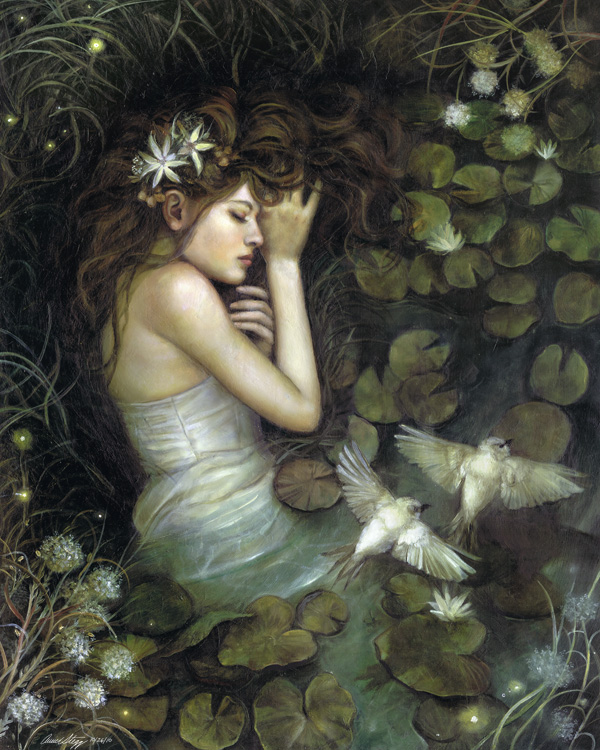
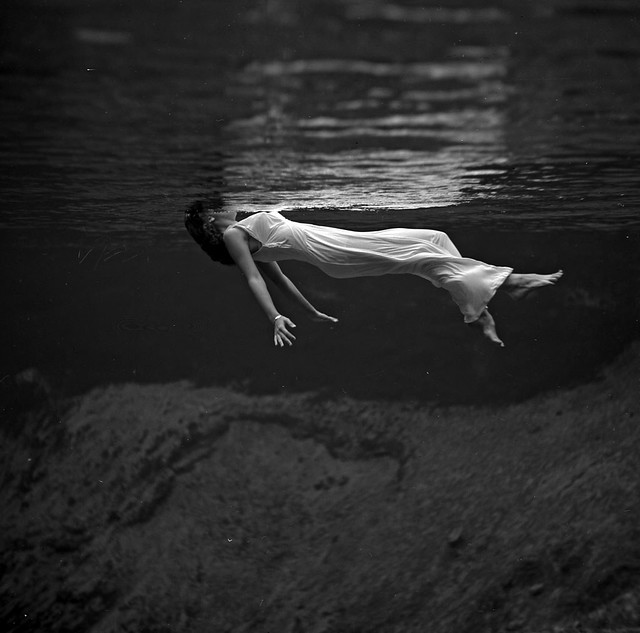
 These two pictures are modern depictions of what Ophelia's drowning must have been like.  Pictures carry such emotion, and I love both of these interpretations of the event.  


I have developed a curious interest in the character of Ophelia.  I would really like to explore her character and how Shakespeare developed female characters in his works (a little character analysis + a little textual analysis = a content writer of a research paper).  This topic would allow me to pick apart one of Shakespeare's works in order to develop a better understanding of Shakespeare's writing style, which would help in my future readings of Shakespeare's works...I think I would like to read them all.  Shocking.  I know.  Reading his works in a more focused way than just rushing through the reading of a play then moving on in the class has allowed me to savor the writing style and the character development, which I mentioned are two of my favorite aspects of writing, especially the use of symbolism to communicate an idea.  And to me, Ophelia definitely stands as a symbol.  I know I should have some backup ideas, in case this does not work out, but I really hope that it will.  IF it doesn't, I would like to analyze another female character in one of his works.  The part they play is truly intriguing to me, and I would like to explore it further.

Friday, February 3, 2012

Ophelia Falling

While talking to my roommates about Ophelia drowning, one of my roommates told me about a beautiful picture that depicted this scene.  I do not know if this is more or less graphic and disturbing than the manga picture.  What do you think?


Manga- A New Experience


First off, my roommate who reads manga informed me that this book was not manga, but a graphic novel.  Does anyone else have an opinion on this matter?

Reading this version of Hamlet was interesting.  I really liked how there was a visual representation of the action of the play.  This helped to keep the characters straight and to better understand the action.  One thing that I really appreciated was that even in black and white, the intended mood of the art came through strongly.    This obviously is not the only way to approach Shakespeare, but I feel that this would be an especially good way to engage middle school age students in his work.  In addition to Hamlet, other Shakespearean plays have been transformed through this publishing company.  I would be interested in looking how other plays are taken to comic form.

On page 137-138, Laertes learns of Ophelia's drowning.  I really liked how on just two pages, they described and showed her death.  It was beautifully accomplished.  The first page shows Ophelia falling to the waters of her death, and the second page shows her sinking towards the plants at the bottom of the ocean.  The tragedy of her death is very well communicated.  Were there any spots in your graphic novel that you felt helped you to understand the scene better than before?

Wednesday, February 1, 2012

"Pity me not, but lend thy serious hearing To what I shall unfold."


Hearing is key to many things that we do each day, such as crossing a street (Frogger, a dangerous but frequent activity for many BYU students) or listening to a song.  When reading a book, one does not always think about hearing, since much of our reading is performed silently.  With the announcement that our main Shakespeare work to study was to be experienced in audio format, I was a little weary.  In my Writing About Literature In the Digital Age class, I read two books in audio format, and I struggled a bit.  Having listened to part of Hamlet...things have not changed much.  As I mentioned on my blog for my last class, I like to hold the physical book while I am reading.  With audiobooks, you cannot see the words upon the page, and it is difficult to go back and forth between different passages.  Trying to find a passage is hard unless you have marked the time frame that it took place in your notes somewhere.

Hamlet, being a play, was better than trying to read an academic book in audio format.  However, since the language is from another time, I found it frustrating while listening to dissect what was taking place at times.  This brings me to the commentary.  I am still trying to figure out how I feel about this addition.  On one hand, I love the background information and what it adds to your understanding of the play.  But this commentary can be distracting and at times separates you so much from the action of the play that it is difficult to stay connected with the flow of the play.


I have never read Hamlet before, so I am intrigued by the Hamlet and father's ghost conversations.  Shakespeare is great at making the extraordinary seem ordinary, and the ordinary appear extraordinary.  Hopefully, I will be able to gain some insight through experiencing Shakespeare in this new format.  As the ghost says, "Pity me not, but lend thy serious hearing to what I shall unfold."  Has listening to Shakespeare been frustrating or easier than reading it?  Have you found any solutions to make listening easier where audio books are lacking for academic learning?