"Wherefore Art Thou Meaning?"Many times while reading Shakespeare this is the main question on my mind. Through my own pondering & writing and hopefully some comments from others, I hope to find some answers.
When asked to deliver letters for Armado and Berowne, Costard receives payments from each of these men. When Armado gives remuneration, Costard decides that must be Latin for three farthings. When Berowne gives Costard guerdon, Costard also takes this to describe the particular amount of money.
Costard does not quite understand the level of language used by some of the other characters, which is a language of metaphoric discourse. Costard believes that the amount of money has the particular names of remuneration and guerdon. Costard's poor understanding of language is used as a foil to Berowne, who has impressive language skills. This play highlights the importance of language, which is one of the reasons I am loving reading the work.
I love the language of this play. I have seen Love's Labour's Lost performed by Idaho State University during my senior year of high school. The characters' clever use of language (or not) keep the play moving and entertaining. When the King of Navarre and his three lords, Berowne, Longaville, and Dumaine make an oath to study for the next three years and fast, while getting little sleep and avoiding women. Longaville and Dumaine agree to enter the pact with the King of Navarre, but Berowne does not think he can handle it.
BEROWNE: O, these are barren tasks, too hard to keep,
Not to see ladies, study, fast, not sleep! (1.1.4)
Berowne thinks that it is wrong to put a man up against his natural instincts.
Then, we learn that the daughter of the French king is about to visit. When Berowne asks the King of Nevarre how he is going to handle this visit, the king says that their interaction will be out of necessity. Berowne catches this loophole, realizing that they will all just break their vow and call it necessity.
BEROWNE: Necessity will make us all forsworn
Three thousand times within this three years' space; (1.1.38)
I have never read this play before, but so far, I am really enjoying it.
Who would have thought that Shakespeare's personal pronoun usage would vary for his comedies, tragedies, histories, and romances? I certainly never thought about it. Way to go, Kaleigh, for exploring this idea through the means of digital humanities! I love how in addition to looking at Shakespeare in a new light, she incorporated work done at Brigham Young University. My Linguistics class has spoken frequently about the Corpora of British and American English or COCA/COHA, and I have to use a similar corpus for my research paper in that class. These corpuses allow us to research words and grammar in a new way, being able to quickly see how many times a certain word is used either throughout history or in the modern world.
Kaleigh argues that a marriage is needed between the two methods of study, traditional methods and the digital humanities movement. They truly do enhance the other. As I mentioned in a previous post, my research paper did not make my argument come alive as well as my blog did with the usage of pictures, videos, etc. I feel this is true for many research papers. They are well written and have a good point, but they lack the energy to really engage the reader in the work. With the use of both text-analytic techniques and the incorporation of digital media, not only would the paper be more engaging to a scholastic audience, but also to many non-scholastic audiences. With Kaleigh's paper, I see her paper being applicable to any person trying to teach or learn. There is something special added when a visual aid is used; the learner is allowed another experience with the idea, allowing more of their own ideas to be formed because they have more information to form them with.
One idea I had for Kaleigh would be to connect Shakespeare's process with the process of a modern writer such as Salman Rushdie, who recently spoke about donating his personal papers to the university archives at Emory. He speaks about how computers and other technology have affected his writing and creative process. It then turns to how archival science and archival access have changed the way he uses his own archives. How would it be to cite a YouTube video in your research paper, or better yet, have that video as a part of your research paper?
As the picture above says, digital humanities are allowing the writing process to transform through technology. We have so much information at our fingertips in multiple formats. Why would we limit ourselves to the written word when so much more is available? That is not to say that traditional writing is not important; this format has been the source of the spread of academic knowledge for years and still has a place in society today. However, the process and format does not need to be set in stone. With the technology available, some bending of the rules should now be allowed to connect with an audience used to getting answers quickly. By incorporating a simple 30 second movie clip of Hamlet, with the scene of Ophelia coming to the water, I feel I would be able to better convey the emotion and psychological processes behind her actions. Kaleigh states in her paper, "Digital humanities allow for an expansion beyond traditional textual analysis, taking the foundation built by good old-fashioned research and broadening the scope of comprehension through new mediums. In this way, digital studies are an essential tool to furthering the research of humanities and texts in the modern age and should not be seen as an unusual and unscholarly, no matter how unconventional the methods of research may appear."
Does this not just say iPad to you? How amazing would it be to pick up a 20 page academic paper in the form of a computer or iPad that allows you to explore the pictures, videos, Powerpoints, etc. that inspired the ideas of the author! This would allow the reader to better understand the thought process of the author and help them to have a stronger basis on which they can form their own ideas on the subject. Another way to show the power of digital humanities would be to discuss the new digital books which are interactive with pictures, videos, and data visualizations.
I do not know if this is where Kaleigh wishes to take her research, but if she wanted a more narrow topic, she could pick a specific area of the digital humanities to explore how the use of digital books or/and archival science would change how people read and experience Shakespeare and his grammar. Great job, Kaleigh! I am excited to see your research and learn more about the digital humanities with Shakespeare's grammar.
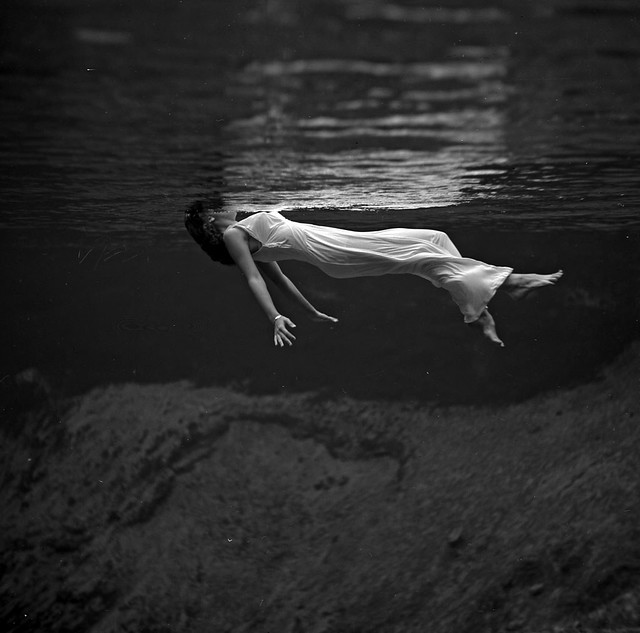
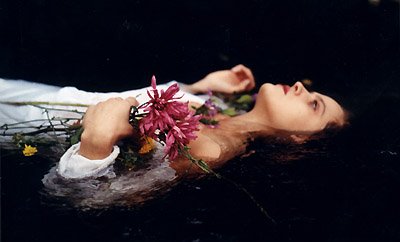
I search for a picture of Ophelia, and one of the first results is a picture shared by our very own Dr. Burton. Just another example of why social networking is so important and helpful.
These two pictures are modern depictions of what Ophelia's drowning must have been like. Pictures carry such emotion, and I love both of these interpretations of the event.
I have developed a curious interest in the character of Ophelia. I would really like to explore her character and how Shakespeare developed female characters in his works (a little character analysis + a little textual analysis = a content writer of a research paper). This topic would allow me to pick apart one of Shakespeare's works in order to develop a better understanding of Shakespeare's writing style, which would help in my future readings of Shakespeare's works...I think I would like to read them all. Shocking. I know. Reading his works in a more focused way than just rushing through the reading of a play then moving on in the class has allowed me to savor the writing style and the character development, which I mentioned are two of my favorite aspects of writing, especially the use of symbolism to communicate an idea. And to me, Ophelia definitely stands as a symbol. I know I should have some backup ideas, in case this does not work out, but I really hope that it will. IF it doesn't, I would like to analyze another female character in one of his works. The part they play is truly intriguing to me, and I would like to explore it further.
While talking to my roommates about Ophelia drowning, one of my roommates told me about a beautiful picture that depicted this scene. I do not know if this is more or less graphic and disturbing than the manga picture. What do you think?
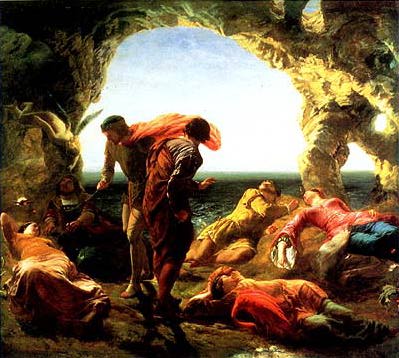
This painting describes the scene where Ariel prevents the murder of Alonso, the King of Naples, and his advisor by Antonio and Sebastian. Alonso and Gonzalo are sleeping, but Ariel sings the words above to Gonzalo. Gonzalo awakes and wakes up Alonso. Antonio and Sebastian make up excuses for their drawn knives. The artist, Paul Falconer Poole, has taken liberty to depart from the text. Three women are in the painting that are not in the play, and Ariel is awakening Alonso instead of Gonzalo.
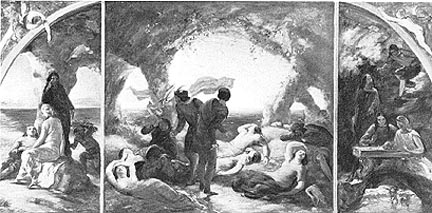
This is an oil sketch of the finished work. No one knows where the two side panels are that depict Miranda and Ferdinand talking (on the left) and Prospero and Alonso (on the right).
"O, the cry did knock against my very heart. Poor souls, they perish'd" (The Tempest, Act I, Scene ii)
There will be more about this picture in my next post.
To begin reading the play, I read a summary of The Tempest, and read about the play on common sites like SparkNotes and Wikipedia. For my next few posts, I am going to be experiencing The Tempest through multiple means of supplementary material. My next post will look more closely at paintings about Act I and II to see how they add to my understanding of the play. Act III, I will find and watch different movie and play adaptations. For Act IV, I will search for student artistic representations of the play. Act V, I will participate in online forums about The Tempest. After finishing the play, I will create something pertaining to the play to try to apply the knowledge that I have learned.
So far, the play has been very interesting. The play jumps right into the action. It was intriguing to think of how Shakespeare set up the beginning of his plays so that people would more quickly connect with the story line. The thunder at the beginning, people running around frantically, and characters such as Boatswain help the reader to understand that what they are witnessing is a boat full of people in serious peril. As I connect with this text, I will be sharing insights on Shakespeare's writing style, because I would like to be an editor someday. Has there been anything about Shakespeare's writing approach in your reading of The Tempest that has stood out to you?
I got my wisdom teeth out last Thursday before coming back to Provo. It was quite an interesting experience to be awake during the procedure, especially not being completely numb for the crushing and removal of one of said teeth. That first day I was feeling great, but as time went on, I left that feeling behind.
For the past week, I have had to be really careful of what I eat. Right now, I can relate pretty well to the cartoon below.
The journey has been interesting, but I am hoping to be able to finally eat, really eat again, soon. I have been having difficulties still pain-wise, but hopefully, if what they say is true, time heals all wounds.
Shakespeare's Sonnet 60 does not share this opinion of time healing all wounds. Sonnet 60 speaks on who time passes and how it affects human life. The first quatrain speaks on how every minute that passes replaces the minute before it. The second quatrain talks about how time begins by giving to human life, but then continues on by taking away what it has given, beauty, strength, etc. The third quatrain goes into describing the monster that is time by telling how it robs beauty from both humans and nature. But then the couplet takes a turn, as couplets often do, where Shakespeare describes his writing as everlasting, despite the powers of time's "cruel hand."
Like as the waves make towards the pebbled shore, So do our minutes hasten to their end; Each changing place with that which goes before, In sequent toil all forwards do contend. Nativity, once in the main of light, Crawls to maturity, wherewith being crown'd, Crooked elipses 'gainst his glory fight, And Time that gave doth now his gift confound. Time doth transfix the flourish set on youth And delves the parallels in beauty's brow, Feeds on the rarities of nature's truth, And nothing stands but for his scythe to mow: And yet to times in hope my verse shall stand, Praising thy worth, despite his cruel hand.
Time may heal, and time may hurt, but time is always constant. Beauty is fleeting. Writing may be destroyed through time, but the reputation of either or both can last forever, such as Sonnet 60. See...I might have a little wisdom left after all.
I will be honest. Shakespeare has never been my favorite writer. I appreciate everything that he has done for our culture and language, but I have always struggled to be absorbed in his writing. When I was faced with the decision of choosing which major author class to take, I originally thought, "Anything but Shakespeare." Then, I began to think, "But maybe...that is why it is the right choice for me. What better way to develop a love of Shakespeare then to take a semester long class completely focused on his works?" When looking at the different course descriptions from the various professors teaching the subject, I saw Dr. Burton's name. I really enjoyed his class during spring 2011 where we looked at literary works through multiple lenses and incorporated the changing ways of gathering information through technology to revolutionize the classroom experience. This section was the right section for me. I remembered Dr. Burton's love of Shakespeare and knew that he would teach it in a way to help me gain a better understanding of Shakespeare's work.
In the past, I have read a handful of plays and another handful of sonnets, my favorite so far probably being the play King Lear. I am looking forward to experiencing some more of Shakespeare's works and developing a greater understanding of them.
Through my reading of Shakespeare this semester, I plan on focusing on the analysis of the words upon the page (or in the case of this class, upon the screen). I will focus on the meaning of different passages and on Shakespeare's literary style. My other focus is something that I discovered I cared a lot about in my last class with Dr. Burton, which is e-Learning, incorporating electronic forms in learning and teaching. I want to explore new ways to explore Shakespeare in this way, that could possibly help future readers of Shakespeare to develop a love of his works at a younger age. This semester will be very exciting, and I look forward to discussing these ideas with Dr. Burton and my fellow classmates & bloggers.